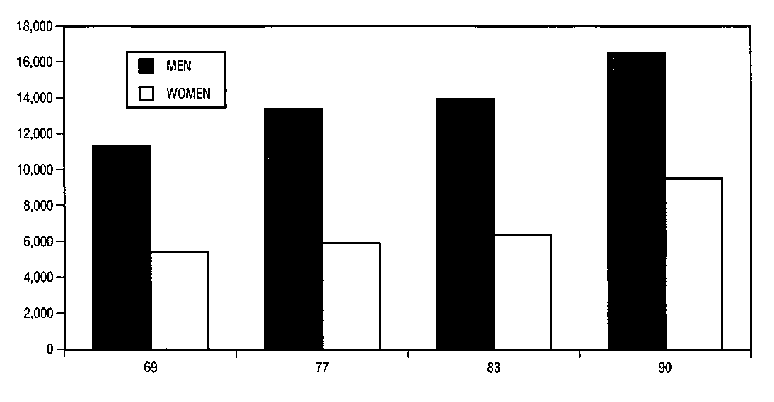
Figure 2-1 Average Annual Miles Per Licensed Driver, 1969-1990
"Change is inevitable. In a progressive country change is constant."
--Benjamin Disraeli, 1897
As more people enter the driving pool, the roads of the United States are becoming congested and unsafe. Some change in the United States transportation infrastructure must take place, because it is not feasible to build more roads. One of the solutions to this growing problem is the creation of Intelligent Transportation Systems (ITS). One of the components of this system is autonomous vehicles.
An autonomous vehicle can simply be explained as a car that drives itself. The popular image that comes to mind when this is mentioned is Kitt from the television show Knight Rider. To develop a vehicle like Kitt may sound incredible, but it is possible and may be a commercial reality in the next 5 to 10 years. During the last two years a team at Princeton University has been developing an autonomous vehicle.
The work done over the last several years at Princeton is with a golf cart that has been modified to make it autonomous. One of the primary focuses is on the design of the control and communications system. The golf cart project consists of a vision system in a computer that is connected to a "box" on the golf cart, that runs the car based on signal output from the computer. The communication between the computer and the car has been the weak link of the project. The vision system has not been able to communicate with the golf cart. This year, after looking more closely at the input/output system on the computer being used, the previous problems have been resolved.
Not only is the implementation of this research important, but also the reasons for doing it. Autonomous transportation is one of the way's in which vehicle technology is developing. How to efficiently get a person from Point A to Point B, while still allowing for personal autonomy, is a difficult problem. Given the constraints of the existing physical road system, there are limited developmental paths. In viewing the proposed development of ITS, and the reasons for developing them, helps one to gain an appreciation for the impact of these technologies. It also allows one to see where autonomous vehicle research will eventually be used.
Not only are the ideas about ITS and autonomous travel important, but also important are some of the issues raised. Who is going to be responsible for this technology? Will it lead to less privacy for individuals? Is automation a good thing? These are just some of the issues that are raised when discussing this technology.
Developing the control and the communication system for an autonomous vehicle, allows one not only the chance to create an autonomous golf car, but also to see first hand some of the possible problems there will be with the creation of autonomous fleets. From this, one can determine how it would be best for these technologies to develop.
Autonomous vehicles are a reality for the future. It is how they will develop and be used that is still unknown. The reasons for the development of autonomous vehicles are clear: personal convenience, increased safety, reduced congestion, and environmental benefits. The implications of this development on our society are not.
Chapter 2: The Development of Autonomous Vehicles in the United States
The reasons for the creation of autonomous vehicles are varied and growing. Some of the reasons come from the physical overloading of the roadway infrastructure. As the use of cars by individuals increases, the congestion on the roads gets worse and the safety of driving becomes more of a concern. There are other factors, beyond these structural reasons, for the development of autonomous vehicles. Changes within the automotive industry, new technology, and government support in the early 90’s, only increase the reality of autonomous vehicles. These growing concerns, along with plans for the development of an Intelligent Vehicle-Highway System, are important to the creation autonomous vehicle technology.
2.1 People and Cars and the Government
2.1.1 Travel Patterns and Congestion
The amount traveled by individuals in cars is increasing. Figure 2-1 shows the average miles per a licensed driver. The number of miles driven is just going to increase as time passes and population centers continue to grow. As the miles driven increases, so does congestion. Almost a third of the miles traveled are miles traveled to work. Many of those miles filled with congestion. There is a need for some change in travel technology, to help alleviate the loss of productivity, energy waste, and emissions increase. These problems are caused by too many cars on the road competing for limited space. These are the side effects of an outdated and overused road system, and they are becoming increasingly unacceptable in our society. Productivity is important and it is lost with congestion.
Figure 2-1 Average Annual Miles Per Licensed Driver, 1969-1990
Travel patterns in the future are not expected to change in any significant way. Each year more and more cars are sold. In places like the Bay Area, the commute time continues to increase as people push their residences further and further inland, away from the workplace. The median travel time is staying the same because half the commuters moved closer to their jobs, while half are moving farther away. This means that more commuters are traveling longer distances. According to a demographic trends tracker, "People are willing to commute further distances to find affordable housing and still not have to be within an urban environment." Commuting has become an accepted but hated part of life, as the freeways and road structure do not keep pace with population growth.
The existing road infrastructure has limited expansion opportunities. This is due in part to the cost of the land, but there are also environmental factors that discourage the creation of new roads. Residents do not want major highways to go through their backyards, but they are also intolerant of congestion.
There are no doubts about the increased usage of the existing infrastructure. Public transportation systems are seen by many to be an inconvenient and costly alternate to driving. In San Jose, California, more people walk to work (3.5%) then use mass transit (2.9%), despite an increase in transit service. Solo commuting is also increasing, even with public campaigns aimed at getting commuters onto mass transit or into carpools. Given this situation there are limited opportunities for improvement to our national transit troubles. As transit problems are made less of a problem, is improved mobility and convenience something to strive for, or will it just lead to more problems.
Congestion on the road has two other significant impacts. Travel is not energy efficient and emissions levels are only made worse by the stop and start nature of traffic. People seem unwilling to use more public transit or car pooling, so some other measures must be taken to alleviate theses environmental concerns.
2.1.2 Safety Considerations
Safety is another a major concern. Running off the road, what highway safety bureaucrats term a "single-vehicle highway departure," is one of the most deadly types of accidents. It kills about 13,000 Americans each year, 37 percent of automobile fatalities. In an average year, more than 40,000 people will die in traffic incidents, and another 5 million will be injured. Increased safety is an important concern. Air bags and anti-lock brakes are seen as necessities in cars. The use of air bags and seat belts only helps drivers after they have gotten into an accident situation. Things like brake lights and anti-lock brakes help the driver prevent accidents. These measures help to improve safety, but something more needs to be done to prevent the accident from happening. Driver error needs to be reduced, as it is one of the biggest creators of traffic accidents and incidents.
Americans seem unwilling to give up convenience, even though driving cause numerous deaths each year. This can be seen in the popular recent law that allows for the increase in the speed limit beyond 55 miles-per-hour. In 1974, the 55 miles-per-hour speed limit was introduced primarily to save gasoline. A side effect of this change was a decrease in the number of people who died in auto accidents. More than one half the fatal accidents in the United States happen on rural roads, due to poor road conditions and high speeds. When, in 1987, the speed limit on rural roads was increased to 65 miles-per-hour, the average yearly death per mile driven increased by 17.6 percent on rural roads. While there are more safety features in cars, road fatalities have still increased overall by 2.4 percent. The increase in the speed limit is just going to add to danger of accidents. Allowing higher speeds may make drivers happier, but will also lead to increased damage due to driver error and more deaths.
Our society needs the vision and technology to make highway driving efficient, safe and predictable. This may not be possible, but at least highway driving can become a lower stress affair and a more productive time for the user. There is a need for substantial improvements in traffic safety.
2.1.3 ISTEA
It is under the conditions of congestion and a need for safety, that the Intermodal Surface Transportation Efficiency Act of 1991 (ISTEA) was passed. The purpose of ISTEA is "...to develop a National Intermodal Transportation System that is economically efficient and environmentally sound, provides the foundation for the Nation to compete in a global economy, and will move people and goods in an energy efficient manner."
The ISTEA legislation calls for an Intelligent Transportation System (ITS). It is thought that development in this area will help alleviate some of the congestion, safety and other highway problems. The goals of the program can be seen in Table 2-1. It is hoped that if these goals are realized there will be
|
Goals of ITS in the United States |
|
Improved Safety |
|
Reduced Congestion |
|
Increased and higher quality mobility |
|
Reduced environmental impact |
|
Improved energy efficiency |
|
Improved economic productivity |
|
A viable United States ITS industry |
Table 2-1: Goals of ITS in the United States
increased productivity in the United States. If this program is going to be successful then a coherent and functional plan must be created and developed. The American government is being very supportive of development in this area. They are planning to spend up nearly one billion dollars for research into ITS.
2.1.4 ITS
At this point the plan for the development of ITS has five functional areas.
The Advanced Traffic Management Systems are the base of ITS. They will collect and distribute information about road and driver conditions. They will also control traffic lights and metering ramps in order to better manage the flow of traffic. At some point in the future they could even control driver routes. Advanced Traveler Information Systems provide information to the traveler, probably via onboard navigation systems. Advanced Vehicle Control Systems increase safety by enhancing the vehicles controls in dangerous situations. This included collision avoidance systems and eventually the use of autonomous vehicles. Commercial Vehicle Operations is just he continuation of information gathering from the commercial sector. Advanced Pubic Transportation Systems will be an improved mass transit system that will use all of the other ITS technologies, to make mass transit a viable option.
The integration of all of these systems should be greater than the sum of its parts. It will allow for better transit due to use of some existing and some yet to be developed technology.
ITS is an advanced user service that does not fundamentally change the existing roadways, but conceptually changes how they are used. The benefits of ITS can be seen in Table 2-2.
|
BENEFITS OF ITS |
|
More vehicles can be accommodated on the highway. |
|
Driving safety will be significantly greater. |
|
High performance driving can be conducted in adverse weather and environmental conditions. |
|
All ITS driver can be safe and efficient drivers. |
|
Fuel consumption and emissions can be reduced. |
|
Land can be used more effectively. |
|
More efficient commercial operations. |
|
More efficient transit operations. |
Table 2-2: Benefits of ITS
Autonomous vehicles are one part of the development of ITS. They are necessary to help improve road usage. In some ways autonomous vehicles can alleviate the problems that are plaguing the road structure of America. With ITS there is now increased funding to look into the concepts surrounding autonomous vehicles, or smart cars. Western Europe and Japan have already invested a lot of time, capitol and energy into smart cars. Now that the United States realizes the importance of this technology, it can expand into this area.
2.2 Automotive Industry and Electronics History in Cars
Today, the automotive industry is going through a period of change. These changes, both in the industry and what the public is willing to pay for, have some direct implications on the development of autonomous vehicles.
In 1970, the typical car contained approximately $75 in electronic components. In the mid-1970’s, the use of automotive electronics increased. This happened as a result of two conflicting goals: increase fuel efficiency and cut exhaust emissions. Computerized engine-control modules are more accurate and reliable than conventional mechanical ignition systems, and are therefore able to handle the conflicting optimizations.
Today, the average automobile has about $2,000 worth of microprocessors and related hardware on-board, controlling everything from the anti-lock brakes to the power windows. On luxury cars the figure tops the $3,000 mark.
According to Gary W. Dickinson, president and CEO Delco Electronic, a subsidiary of the General Motors Corporation, "No device you operate in your daily life has more electronics and controls than the automobile." There is an increased reliance of car owners on these electronic features. Many car owners think the benefits that come with them are necessities.
In the area of electronic features, a number of manufacturers, such as Eaton Vorad Technologies, have developed collision-avoidance systems. Using low-power radar, vision systems, or laser beams, they alert the driver when to brake, giving drivers up to four seconds of additional reaction time to avoid mishaps. The next step will be to link these systems to a "smart cruise control" system, which can maintain a safe distance from the car ahead, even if that vehicle is constantly altering its speed. These are the first steps toward developing completely autonomous vehicles.
2.3 Acceptance of this Technology
Americans want reliable, efficient, and safe machines. If these features can be found in autonomous vehicles, then why would consumers not use them? Already automation is a part of many peoples lives, taking the place of routine, repetitious tasks. The next step is for it to take the place of driving.
The electronic technology exists and continues to be developed. Anti-lock braking systems can prevent a skid by linking a car's brakes to a microprocessor. This technology is not like cruise control where the driver sets the control and is in charge, but is a case where the technology, the car, is making the decisions. Many people chose to buy this technology, this automated technology, so why would they not purchase the next step, which would be a car that controls longitudinal and lateral movement.
An example of development of features for safety is the air bag. It was originally developed in the early 70's. The auto makers did not put air bags into cars or market them until the late 80's. They did not think people would want to purchase air bags. Now they are in almost every new car. Technology that is strongly linked to safety, can be loved by the public, even if there is a price.
The automotive industry needs to continue its development of new technology. Americans buy technology. Recently, General Motors came out with an electric car in California. The car conforms to California’s tough new environmental laws. This is a risky and new venture into a previously ignored market. The automotive industry is willing to make risky development decisions, for the possibility of huge market share. This should not be any different for autonomous cars.
Americans also have a tendency to under price the cost of owning and driving a car. The highway infrastructure in the United States has been largely funded by the government, from money derived from the gas tax. Individuals do not directly pay for road usage in the United States, they pay indirectly. This means that the cost of driving is actually more than just the out of pocket cost of a car insurance and gas. It also includes the cost of building and maintaining roads, and the environmental cost of using cars.
The transit use in the United States needs to more seriously reflect the actual cost of using the different transit options. The cost of using the existing roads is much greater than the perceived cost. One of the ways to increase the perceived cost, beyond creating toll roads, is congestion pricing. Congestion pricing in making people pay for the use of roads. They pay not just for what roads they use, but also for when, and what amount of traffic they create. Things like congestion pricing are made easier by some of the new technologies developed along with autonomous vehicles.
Nobody knows how big is this ITS market is. It has just begun to emerge. Despite a few widely publicized tests such as the TravTek evaluation currently underway in Orlando, Fla., ITS is so new that the market is still in its developmental stages. The Strategic Plan of the Intelligent Vehicle High Society of America suggests an ITS market of $300 billion over the next 20 years. Their is the possibility of a huge market. It is not in the interest of auto maker to dismiss this potential market.
The first impact of these technologies, like smart cruise control, is on the trucking industry. They have begun to be installed in trucks from the Great Lakes region to Arizona. In time, they should move into single passenger vehicle market.
The trucking industry tends to pave the way for the development of new road technologies. An example of this can be seen in toll roads. The reason for the existence of toll roads, is that the trucking industry saw the safety benefits of using the first toll road, The Pennsylvania Turnpike, to be greater than the cost. After the first toll road was accepted, many more toll roads were developed.
For the trucking industry, an industry with more than 100% turnover rate and huge safety concerns, autonomous transportation could have an important positive impact. Already, Mercedes has developed some vision based warning systems for use in trucks.
Trucking is a type of motor vehicle operation that stresses getting the job done. Improved operating efficiency, safety and convenience in handling inspections, record-keeping, permitting and tolls provide incentives to motor carriers to adopt intelligent transportation systems, just as they accepted the first toll road.
2.4 Development of this Technology
The new automotive technologies are moving in many directions. Some of the new technologies are just extra tools for the driver. Examples of this are the navigation systems that guide drivers. The other route of development is toward autonomous vehicle. An example of this is smart cruise control. One of the areas in which researchers should focus, is on developing a vision system that could serve as a second pair of eyes, ready to warn a sleepy, distracted or intoxicated driver that his vehicle is veering dangerously toward the edge of the roadway.
The development of vision based technology is one of the more important factors in the creation of autonomous vehicles. It allows autonomous vehicles to respond to the environment in the same way humans respond. If there is only central control of autonomous vehicles, then there are some difficult problems to overcome. These problems are: possibility of system malfunction, users lack of personal control, and creation of extra road space specifically for the autonomous vehicles.
Unless ITS is developed along the lines of Personal Rapid Transit system, where the physical structure is set, then I do not think central control is feasible. The possibility of system failure and the response to such problems needs to be more fully researched. Total lack of driver control, leads to complacency that can be dangerous t the driver.
While autonomous vehicles may seem radical, the United States has a history of integrating into its transportation system seemingly radical technologies. Eventually the new technologies become commonplace. Examples are computers, typewriters, HOV lanes, and ramp metering. These technologies first encountered resistance, but are now wildly accepted. Still there are many issues that need to be resolved, as shown in Table 2-3, and without that resolution, the acceptance of the new technology of autonomous vehicles will be slow.
|
Areas |
Issues to be Resolved |
|
Safety |
Is this safer? What is the malfunction management like? |
|
Ease of Use |
Is this system easy or complicated for the average user? |
|
Social Benefits |
Will this Technology have a negative impact on society? Will this adversely effect other drivers? |
|
Support: |
Where is the support coming from? Government or Industry or the Public? |
Table 2-3: Issues to be Resolved
Using part of the existing roads for Autonomous Lanes may also be opposed. Drivers have had some negative responses to HOV lanes, because they use up existing roadway and force more traffic into fewer lanes. The same feeling would probably arise with Autonomous Lanes. With internal operation comes the ability to utilize the existing roadways and keep control firmly in the hands of the users.
One of the first steps will be the development of a system known as autonomous intelligent cruise control. This system can automatically maintain a safe distance behind the car in front, drivers can switch this system on or off.
The benefits of this type of system, as shown in Table 2-4, are great.
|
Benefits of Autonomous Vehicles |
|
It does not become tired. |
|
Its sensors are generally superior to those of a human. |
|
It has faster reactions. |
|
The computer never panics. |
Table 2-4: Benefits of Autonomous Vehicles
Not only do they decrease congestion and increase safety, but they allow for new types of road use development. Autonomous vehicles can report position back to a planning center to help in dynamic traffic control systems and congestion pricing. Also, with the development of ITS come the money for the development of better mass transit systems, and possibly for the development of Personal Rapid Transit systems. The roads of American may become part of a new type of national transit infrastructure.
2.5 What Is Being Developed
There are many developmental routes for autonomous vehicles, from centrally controlled systems, to unit controlled systems. The technology that is being developed varies from entire systems to parts of systems. This is all leading down the path to the development of ITS. This is an area where there is a lot of money, both for academics and in industry, and also a lot of lobbying.
2.5.1 ADVANCE
The city of Chicago is the developing the ADVANCE system. ADVANCE stands for the advanced driver and vehicle advisory navigation concept. The ADVANCE navigation system relays traffic information to 4,000 vehicles. It is trying to cut back on congestion and help people be able to make better route planning choices.
This is an example of an advanced traffic management system. While it does not use autonomous vehicles, it is an important first step. The ADVANCE system begins the process of integrating electronic intensive cars into the general population.
2.5.2 Heads-up displays
Another area of development in cars is heads-up displays. They are likely to look similar to the head-up displays common in military aircraft. Pilkington Auto-Optics is working on coating the windshield with a virtually transparent gray paint. The driver can see through the paint without any difficulty. However, an image can be projected onto the paint through a system of lenses and mirrors, like a movie screen, and the driver sees the image apparently in front of the windshield.
This is the type of technology my Father is interested in, because it allows the driver to look at the road and not at a dashboard. This is a change that he thinks will increase safety. I think it could be very beneficial, especially in trucking and military operations. So far there is a demonstration car that displays the prevailing speed limit on the windshield. The information is transmitted to the car from a roadside radio beacon. The system could display other details including speed of the car, engine revolutions, route guidance directions and outside temperature.
The head-up display could also show the output from an infrared camera, so that a driver peering through the windshield into limited outside visibility would be able to see quite clearly the infrared image of a person crossing the road. This type of development has obvious safety benefits.
2.5.3 Research at Carnige Mellon University
Researchers at Carnige Mellon University have developed many autonomous vehicles. In their Navigation Laboratory they have built a system for autonomously driving in an unstructured outdoor environment. Their vehicles combine sensing, sensor interpretation, planning, control, and testbed vehicles to create integrated navigation systems. They drive autonomously as far as 21 miles at speeds up to 55 mph; travel over cross-country terrain for hour-long runs; perform suburban delivery missions; and even park themselves. During the summer of 1995, one such vehicle, called RALPH, completed a somewhat convoluted coast-to-coast trek called "Hands Off Across America."
Their system starts with 3-D perception data from an onboard scanning laser rangefinder, sonar, radar, and trinocular stereo vision system. From these several levels of representation can be produced: rough locations of quickly detected obstacles, locations and descriptions of landmarks and significant objects, or detailed elevation maps. Using the elevation maps, the planning and driving systems avoids obstacles, recognize landmarks, and cross moderate off-road terrain. Other perception-based systems have demonstrated autonomously finding a parking space and parallel parking; convoy following; computer-aided teleoperation; and position estimation. Their vehicles, provide convenient testbeds for autonomous navigation. Every road or highway does not need to have wires or some other type of special system, if you develop intelligence into the vehicle, rather than the road.
2.6 The Future
So far, work in ITS has been driven by a group of visionaries, who have made a strong case that the potential benefits warrant government efforts to bring it into existence. There are clear benefits to the public sector: more efficient use of the roads and the larger transportation system, reduction of traffic accidents and the possibility of managing traffic to control pollution. The problem is that ITS requires substantial consumer expenditures, estimates range from $1,000 to $3,000 per car.
Intelligent transportation systems provide a new way to improve and streamline highway operations. What is even more exciting is that other developments, such as smart cruise control, will soon be in use. The world of transportation is changing. This technology is just the beginning.
Chapter 3: The Design of The Princeton University Autonomous Vehicle
3.1 Overview
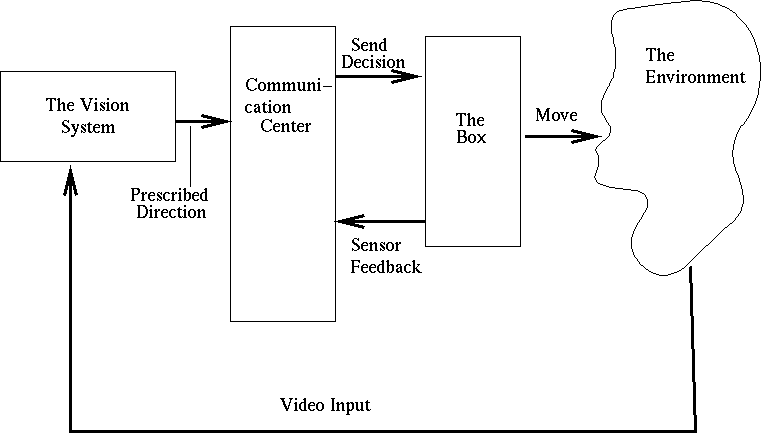
A team of researchers at Princeton University is developing an autonomous vehicle. The autonomous vehicle under development is on a golf cart platform and follows the design specifications of the Unmanned Ground Robotics Competition. The base vehicle is an E-Z-Go golf cart. The sensor system is a vision based system, that receives images of the roadway from a VHS video camera and then processes those images on a computer that then determines steering commands. The computer used is a Silicon Graphics Iris INDY workstation. It has a 150 MHz R4400 processor and a built-in video image digitizer and is able to transfer video signals to memory quickly, in the order of 0.001 seconds. The computer is connected to a "box" of electronics from which the computer receives information on the current speed of the vehicle and current wheel angle. The computer outputs its control commands to the box that then implements the commands on the Golf Cart. See Figure 3-1 for a diagram of the setup of the system.
The vision system comes up with commands that are checked against the sensor feedback. The sensors supply the computer with measurements, independent of its visual system, of the speed of the vehicle and the angle of the front wheel. These are to ensure that the instructions coming from the computer are effective in commanding the vehicle, and to provide more data about the environment that the car will soon encounter. Combining these with the analytical and computational abilities of the computer program gives the golf-cart the ability to run along relatively complicated courses. 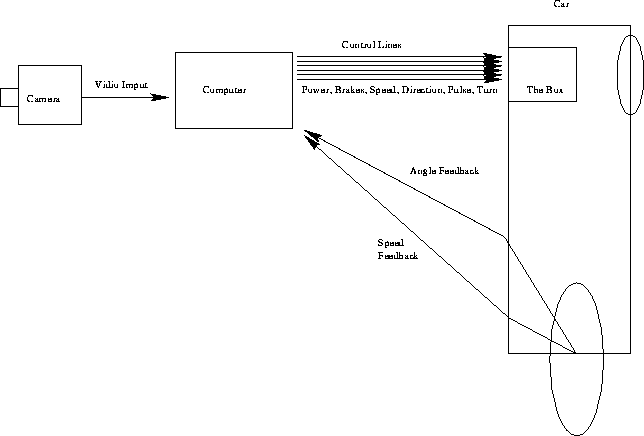
Figure 3-1: Setup of the System
A switch on the "box" distinguishes between transport in manual mode and transport in autonomous mode. Driving a car manually means that a human is in control of the mechanics. To drive a car autonomously, mechanical and electrical components carry out the necessary operations as the human driver. A stepper motor addresses the problem of changing the wheel angle, and a relay allows variation between two speeds. Relays switch the car from off to on turn the brakes on and off, and from forward to reverse. Also, a remote control emergency stop (E-stop) mechanism mounted to the right side of the driver's seat regulates the vehicle if it must be suddenly stopped.
3.1.1 The Computer
This project involves major amount of computer code and work with computer hardware. For this a certain level of comfort with the elements of computer hardware, specifically the parallel port, and also the wiring and setup of the "box" to control all the wires, must be obtained. The "box," developed by Rob Corbin and Michael Ibson, and is the link between the computer and the physical system. Besides understanding the physical system, it is important to understand the image processing system. The connection between the two is critical when dealing with real-time timing issues.
The two systems have been extensively developed and documented. As they are fine tuned, a link has been created between them. Once the code was complete it was possible to see the potential problems in the implementation of the control and communications system. This include the fact that the vision system is processing images at a rate that is greater then the physical system can implement commands. An example of this is that the time it takes to implement a wheel turn of just one degree, is much greater than the time it takes the computer to process several images and sends several of those commands.
The research into other types of autonomous systems has uncovered some of the potential problems that the implementation of the interface may encounter.
3.1.2 The Golf Cart
The Golf Cart has on it a "box" that integrates the sensors and controls for the car. It provides angle and speed feedback to the computer, and executes the commands sent by the computers. The box can switch the ca from autonomous to regular mode. The Golf Cart has been tested and work in regular mode.
3.1.3 The Vision System
The vision system is a vision based tracking system developed by Hongtao Jiang. The system identifies the road geometry by selecting candidate points for the white marked lanes using a scan-line correction method. The detected points are then linked in a transformed plan-view feature image by applying a recursive piecewise linear fitting scheme. The path tracking algorithm is based on the pure pursuit strategy. The vision system has been extensively tested and debugged. When connected via the computer to the Golf Cart, it should be able to detect enough information from the images and feedback to steer the car.
3.2 Communications
3.2.1 Parallel Port Information
Information has been compiled about the parallel port, which will be the means of communication between the Golf Cart and the vision system. After much testing this important information about the physical system has been determined.
Pins on the parallel port that can be read from and how they will be used can be seen in Table 3-1.
|
Pin Number |
Primary Use |
State |
When Low Receive |
When High Receive |
Golf Cart Use |
|
12 |
PE |
high |
2 |
0 |
Speed Sensor |
|
13 |
on-line |
high |
8 |
0 |
Angle Sensor |
|
15 |
fault |
high |
0 |
1 |
Extra |
|
17 |
No Ink |
high |
4 |
0 |
Angle Sensor |
Table 3-1: Pin Input Information
Information is read in two ways. One way is by a loop that checks for the leading edge on the input and increments when there is a change. This leading edge indicator is used for getting feedback from the speed sensor. The other method involved handshaking to an A to D converter that returns angle sensor information.
The strobe on the parallel port sends output at a frequency that is equal to that of pins 10 and 11. Both of those pins must receive input for the communication between computer and car to work. The strobe when the parallel port is open. The "box" uses the strobe set commands when no new information is being sent. The lower limit on the frequency sent to pins 10 and 11 is set by the demands of the stepper motor, and the upper limit by the reading ability of the machine.
Each data line on the parallel port controls a different functionality of the Golf Cart. The data lines are pins 1-8. Pins 1-6 are used to control the car. Pins 7-8 are used in the handshaking for angle feedback. The use of the data lines can be seen in Table 3-2.
|
Pin # |
Use |
High Signal |
Low Signal |
|
1 |
Direction |
Reverse |
Forward |
|
2 |
Power |
On |
Off |
|
3 |
Speed |
Speed 1 |
Speed 2 |
|
4 |
Breaks |
On |
Off |
|
5 |
Pulse |
oscillating |
oscillating |
|
6 |
Turn |
Counter Clockwise |
Clockwise |
|
7 |
Angle Feedback |
||
|
8 |
Angle Feedback |
Table 3-2: Pin Output Information
All but one of the pins receives either a high or low signal depending on what state is wanted. Pin 5, which sends the pulse to the stepper motor sends and oscillating signal that runs for a set duration. That time is the time it takes to process an image.
3.2.1 Speed Sensors and Control
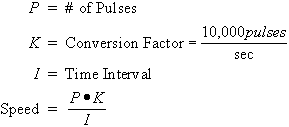
The speed feedback is important for keeping the car within a set velocity. Through the parallel port a number of pulses are read over a discrete time. Information can be received from the pins within a discrete time, but the fact that process time is not always given to the same process, means that a interrupt handler of some type will need to be created to give the port time to be read from, and to make sure that time is a true time. The number gathered is converted into a value in miles per hour. The way in which this works is shown in Figure 3-2.
With the speed information gathered from the sensor, the computer runs through a speed control loop. In that loop it checks the status of the different systems. The four systems that are checked are: Direction, is the car forward or reverse, Speed, is the car in Speed one or speed two, Brakes, are in the breaks on or off, and a comparison of the speed received from the sensor to the speed limit of the car. Figure 3-3 is a diagram of what is taking place in the code.
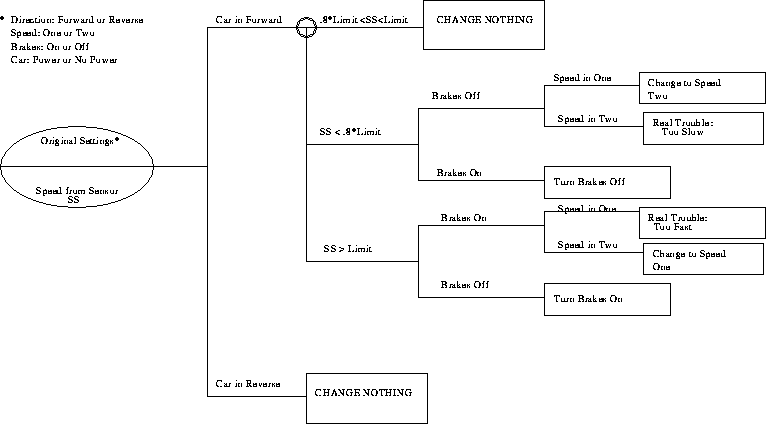 Figure 3-3: Speed Control Loop
It is from the speed sensor feedback that the car can stay within a set limit. This is a very simple feedback loop, but performs an important task. This is applicable to the contest because of an upper speed limit set by the contest. It is also important for maintaining a minimum speed in sand traps and on inclines.
3.2.3 Angle Sensors and Control
The angle sensor has a more complicated feedback system.
The angle information is received from the sensor through an absolute A to D hardware piece. To get information about the angle there is a handshaking protocol with the hardware. On two of the data line the computer sends one of four bit patterns. Then the input lines are polled for bit information. The numbers received combine to give the computer the angle the wheel is at. That angle is then passed to the vision system to help with its calibrations and commands. The vision system is limited to saying turn left, turn right, or hold. It cannot specify an amount to turn. The amount turned is determined by the amount the physical system can turn during the time it takes to process an image.
3.3 Steering Algorithm
Originally it was believed that a bang-bang system of dynamic differential control would work for determining steering. After much discussion and simulation it was found that the bang-bang approach creates an ultimately unstable system. The second solution was one that used second differential equations to determined what to do. The proposed algorithm is simple, as seen in Figure 3-4.
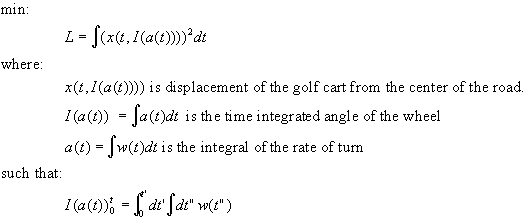
Figure 3-4: Math without Angle Feedback
This formulation has the disadvantage that the stable point is one where the Golf Cart moves parallel to the edge of the road, but not necessarily along the center line. Other attempts to develop steering without angle feedback failed. In all of the alternatives there was concern about the noise in calculating the second derivatives. There was also an inherent wobble in the system, that came from the fact that the turning rate of the physical system is slow. This made any of the alternative steering algorithms, without angle feedback, unacceptable.
Angle feedback is necessary and so was added. This creates a more stable system and a more robust method of control.
3.4 Putting It all Together
As shown in Figure 3-5, the system gathers input from two areas, the vision system and the sensor system, and then makes a smart decision.
Most of the code to this system is completed. It can be found in Appendix A. What remains are issues of tuning and testing to determine some of the limits of the system.
One of the areas of concern is timing and the CPU. There is only one CPU and so its use must be carefully monitored. In a tenth of a second, several actions will need to be performed by both the vision and communication system. There is not only overlap in use of the computer, but a communication between the two systems that must take place. An overview of how time is being used can be seen in Figure 3-6. This timing is not only limited by the use of the CPU, but when commands are sent to the Golf Cart their is also a time delay. So in the time it takes to implement a command, an new command has been generated. This logic is part of the control system. If all of these components work together then the Golf Cart should be able to perform according to specifications. More testing of the interaction of the systems needs to take place before the computer module can be seen as complete and robust.
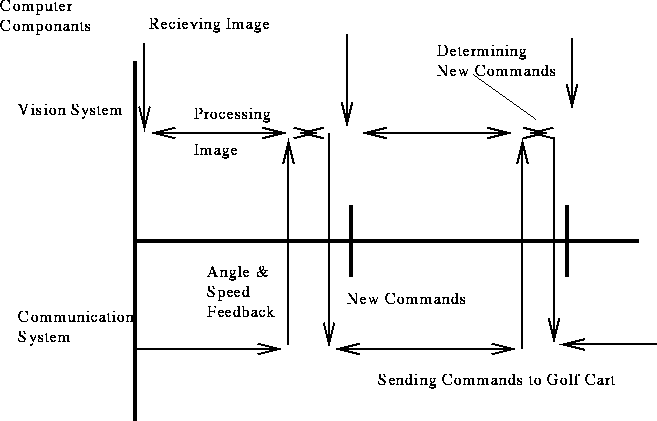 Figure 3-7: Time in the Computer
If, after testing, all the systems run as expected, then the Golf Cart should be a viable entry in the Unmanned Ground Robotics Competition.
Chapter 4: Social and Cultural Implications of Autonomous Transportation
4.1 Industry Development of Autonomous Transportation
The industry has worked on autonomous vehicles, the government has spent money on autonomous vehicles, and academics have developed autonomous vehicles. It is important that time also be spent thinking about some of the major implications of this technology. Are autonomous vehicles reliable and their computer systems safe? Who is accountable and what rules govern these systems? Is this development good for society? How are people going to react to having autonomous vehicles as part of their lives? Right now it is hard to know who is in charge and how safe these vehicles are, but it is important to answer these questions in an effort to pave a smart path to their implementation, especially if their implementation is going to be a success.
4.1.1 Types of Development
Today's cars are amazingly electronic. There is cruise control that the driver can set to make the car drive for him. There are anti-lock breaks, where the cars make a decision for the driver because they are smarter. These are examples of the two roads of development in the automation of cars: the person in charge and the car in charge. As the cars begin to take more control over the driving task, who is going to determine standards and safety protocol. Until now, none of the added electronic features were controlled by government standards. They have been put in and managed by the car companies themselves, and the economic forces of a competitive market.
4.1.2 Who is Responsible?
The creation of autonomous vehicles was originally driven more by political money then economic forces, unlike previous improvements to cars, like air bags. If the government is going to take such a role in their development, then it also needs to set guidelines and rules for them.
Is the developer, the user or the government accountable in the case of autonomous vehicles. The development of ITS and autonomous vehicles is a huge project, with no one person in charge, but development distributed to many individuals. This makes it difficult to determine who is truly responsible for the system.
In classical ethics, there are four types of responsibility, causal, role, moral, and legal. In the last case, laws can be created that determine responsibility, but accounting in the other areas of responsibility is harder to determine. This is the type of project that is going to need to have one sign-off person. One person in charge of everything who will say, "I am responsible." This may be the president of the company, the Secretary of Transportation or the chief engineer. Having one person in charge will lead to better development and a safer system. There will need to be extensive fault verification, and testing on small and large scale, with someone to sign-off each part of the project. That sign-off person should be held accountable for his part of the project, whether it be the vision system or control system. There needs to be direct accountability for the code that is created along with flexible deadlines to allow for good development. If deadlines are not flexible, then there is the possibility of another incident like the Challenger explosion. That aircraft blew up because political pressures to launch lead an engineer to suppress his misgivings about the fight's safety. That type of incident should not happen with autonomous vehicles.
4.1.3 Risks that are Present
There are many risks associated with computers, and these risks can be applied to the development of autonomous vehicles. Autonomous vehicles are amazingly complex systems. No one person will understand all the code. There is not one person in charge to check if all the code all works. The programmers are creating a system in which they may not realize the implications of their code. Anyone can write a book, but society would rather a doctor to write a medical text. Does the same concept of having experts, not good writers, write about their field hold here? Do people want traffic engineers and transportation professionals develop autonomous vehicles? Experienced professionals are good in that they can do a lot of development, but computer professionals are more experienced in software development. Therefore, the code part of implementation should be the programmers job, as long as the specification is done by experienced professionals.
Another risk comes from the fact that this can become a far too ambitious project. One vision of the future is cars going 100 MPH down a road with only one second spacing. Having a fast efficient system that will create more throughput. That is not smart development. Things should be taken one step at a time. First it is important to developed good lateral sensors. With smart cruise control, a user can have a car drive along in cruise drive. The driver sets everything up and the driver is in charge. That is a first step. Next, cars having complete control can be added, with the driver doing nothing. Then development of platoons of cars that go really fast, can begin. If development is unnecessarily ambitious it can lead to problems, but smart development with realistic time frames is not as risky.
Another problem with computer control is that size of errors that develop from things as minor as typos, can be astronomical. It will be important that coding standards not only check the code, but do more of what European countries do and prove the systems. Mathematically go through and check everything to make a more robust system. Just testing, and trying a range of inputs, expected and unexpected, will not alone handle this problem. The size of error's problem will not go away, but smart coding can control it to some degree.
4.1.4 Reliability of the System
The reliability of these systems is always questionable, but if it meets set standards, there is always have a possibility of succeeding. It will be important that the systems for autonomous vehicle transit be internal to the cars themselves. Having a central computer and mobile communications introduces too many risks and seriously threatens the reliability of the system. With on-board systems, like a vision system, the car can do its smart driving, but their will always be a driver that is ultimately in charge.
Autonomous vehicles are being developed by a variety of vendors. This competitive atmosphere may actually lead to a system that is not as safe, as budgets and deadlines breakdown robust development. There is a loss of autonomy in a competitive time driven market. For this reason it will be necessary to have a set of regulations governing the autonomous vehicle systems. Each company will have to follow the same stringent regulations for development. This will help insure safer systems. Since the government is providing some of the funding they can also provide some guidelines.
There will need to be many backup plans and extra wide margins of safety taken into account. As autonomous vehicles are developed it will be important that all safety concerns are taken into account. Many people have unconditional faith in engineers, and that is wrong. When developing the guidelines, it will be important to not develop things that just meet a minimum standard, but to insure that systems are safe far beyond that minimum.
4.1.5 Other Issues
One of the ways to make users of autonomous vehicles more responsible is to institute autonomous vehicle licensing. Autonomous vehicles could have their own license class, like the DMV's motorcycle, car, big truck classes. It is not just the system that can fail but also the user. This would be a way to standardize the system of responsibility. It would be up to users of the system to decide if they are were willing to accept added risk, for much potential gain. As long as this tradeoff is clear to the users, their will be less liability for companies if something goes wrong.
With the development of strict guidelines and an awareness of the risks of computing, safe autonomous vehicles can be created. Giving individuals and organizations legal accountability will also help to create safer cars. Then autonomous vehicles have a future, especially as an early warning system. As such they will be able to be slowly and safely integrated into the roadways of America.
4.2 Legal Issues
Serious questions still remain about such issues as legal liability or the effect of false alarms. Legal responsibility has not been set in the area of autonomous transit. According to one of Ford’s general managers, "Taking more and more control away from the driver and putting it under control of the vehicle creates a whole new legal precedent that must be addressed." In the United States, auto makers may be reluctant to introduce new technology that could catch the blame for every accident.
Without major changes in product-liability laws, Europe and Japan are likely to enter the ITS era long before the United States. This is especially true since they began development in these areas before the United States.
When dealing with the liabilities associated with autonomous vehicles, there are three distinct components: software, hardware and humans. Their is no ITS court cases, but similar technologies such as cruise control and anti-lock brakes have spurred legislation. It was found that with cruise control, the driver is voluntarily delegating control to the vehicle and so can be seen as liable for any damages the car incurs. The general lack of proof of who actually causes an accident and the voluntary nature of driving, may help defendants of ITS technology in court. The issue of who is responsible or negligent in design and the financial ramifications of that responsibility are not yet set. In early court cases in this area plaintiffs will probably be able to recover substantial damages. The precautions noted in Table 4-1, will help in settling liability cases.
|
Precautions for Liability in ITS Technology Development |
|
Keep the technology at the state of the art level. |
|
Safety Features should be included to assists in risk/benefit determinations. |
|
If a system has limitations, do not implement the system. |
|
The technology should leave the driver in control as often as possible, and always allow the driver to regain control. |
|
Announce all safety issues that arise. |
Table 4-3: Precautions for Liability in ITS Technology Development
The computer must be able to detect danger reliably. It must be cautious, without throwing up too many false alarms. Yet it also must not induce false sense of security in the driver, leading to complacency. Balancing these things will be the key to determining who is responsible and what everyone responsibility is.
One of the potential problems in the area of computers is that computers' programs tend not to be developed in as robust a manner as mechanical systems and this leads to problems. No software or computer system is bug free. Since ITS is going to be using a lot of computer equipment, this should be an important area of consideration.
4.3 Privacy Issues
Privacy is of much concern to many individuals, with the development of autonomous vehicles. With the increase of electronics in cars, like GPS systems, it is possible for a central computer to know the position of an individual. This induces feelings of invasion of privacy. If autonomous vehicles are going to be a reality then it is important that the privacy issues be dealt with.
4.3.1 Global Positioning System
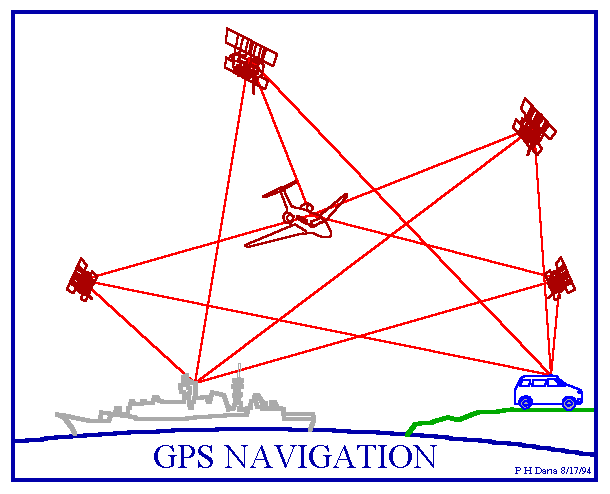
The Global Positioning System (GPS) is a space-based triangulation system using satellites and computers to measure positions anywhere on earth. The Global Positioning System consists of three components: the Space Segment, the User Segment, and the Control Segment. The Space Segment consists of a constellation of 24 satellites, orbiting in 6 planes oriented at 55 degrees to the equator. The Control Segment is responsible for operating the Global Positioning System. The GPS Master Control Station is located near Colorado Springs, Colorado. The primary mission of the control segment is to update the navigational message of the satellites. GPS Receivers are hand-held radio-receivers/computers that measure the time that the radio signal takes to travel from a GPS satellite until it arrives at the GPS antenna. Using the travel time multiplied by the speed of light provides a calculation of range to each satellite in view. From this and additional information on the satellite's orbit and velocity, the internal GPS receiver software calculates its position through a process of triangulation. This process can be seen in Figure 4-1.
This technology has some nice features. With GPS Receiver and a direct satellite connection to a Help Center, drivers will not need to use a personal cellular phone to call for emergency help. There will be an emergency button in the car, that will be able to contact the police and the ambulance, in cases that are emergencies. This is a safety feature, but it also means that someone can know where any individual is at any time. In accepting that additional safety feature an individual must be willing to give up their privacy.
4.3.2 The Privacy versus Information Tradeoff
While the technology is not inherently corrupt, it raises uncomfortable issues of Big Brother,and many people are unwilling to trade information technology for their privacy. What this means is that for ease of use and comfort, drivers will need to give up some privacy. This is not a new issue, but can be seen every day on the World Wide Web (WWW) as people put information on Home Pages in exchange for gaining new information.
This issue of privacy is one that is filled with suspicion of the government and industry. There is a definite tradeoff in this information age, privacy for information. Individuals must give something up to get something, but some individuals do not seem to realize this. They want to take all the benefits, but are unwilling to accept the drawbacks. There must be a balance between personal privacy and public efficiency or ease of use. If people are unwilling to consider giving up their privacy, then they must also be willing to accept congestion and traffic. People are willing to give up privacy for ease of use. An example of this is credit cards. They are easy to use, and so many people use them. In using credit cards, the individuals are then willing to have a public credit report compiled on them. Many people are sure enough of who they are and feel protected enough by the current law structure, to be willing to give up a little of themselves for an increased knowledge about traffic.
4.4 Redefinition of Individual’s Role in Society
Another issue of importance is the impact of automation on our society. How can one be a productive member of an automated society? In the past an individual’s productivity was defined by what they had accomplished, but now much is accomplished by computer. One no longer need a CPA to do your taxes. A computer program can just be purchased. There are no longer professionals, but computer literate workers. The disturbing thing is these workers feel that they are secure in their jobs and performing a great service, when in truth they are lowing the wages of professionals.
What does it now mean to be a professional? Does one need to go to school for an extra 5 years, and get more degrees, or just be able to work a computer program that someone else has developed. Professional skills, like that of a chess grand-master, take years to develop, as the mind has to become able to think in a certain way and deal with a set of situations. Now software can do that. Many people put their brains together and make a software package that can do "anything," like the software program Apache, which can diagnoses medical conditions. When will it end. Will the professionals of our world in the future really only need to be able to work on a computer to be skilled labor. Will the human touch become unnecessary and lost. This direction of computers is unsettling because of the implications it has on society.
Will people feel that automated vehicles are just one more way control is being taken away from them. Is the creation of more autonomous products, a sign of the way in which society is choosing to develop? A sign that individuals no longer need to think but let a system handle all the details for them.
In general, by looking at the issues surrounding the development of autonomous vehicles, one can look at America’s future. If autonomous vehicles and ITS technology are going to be an important part of our society then these issues must be resolved or at least discussed.
5.1 The Contest
The autonomous vehicle that was designed and developed is registered in the 4th Annual Unmanned Ground Robotics Competition. The objective of the Unmanned Ground Robotics Competition is to design and construct a vehicle that will autonomously navigate around an outdoor obstacle course under a prescribed time, while staying within a 5 mph speed limit and avoiding the obstacles on the track. The vehicle must also follow several design specifications: the length must be a minimum of 3 feet and a maximum of 9 feet, the width may not exceed 5 feet, and the height must not exceed 6 feet. The vehicle must be propelled by direct mechanical to ground contact such as wheels, tracks, or pods. Vehicle power can only be supplied by combustible fuel or electric power, and each vehicle will be required to carry a 20 pound payload. For vehicle safety, the maximum speed limit is 5 mph, and the vehicle must be equipped with both a manual and wireless remote emergency stop capability. The contest is June 13 -15, 1996, and will be held in Orlando, Florida. More information about the contest can be found in Appendix C.
5.2 How Our Vehicle Development Will Continue
In order to prepare the golf-cart for the contest, we will continue our testing regimen. The individual parts: vision, communication, and mechanical, have been tested. They are being linked together in steps to insure the systems are working and interacting properly.
We have driven the golf cart in manual mode. The next step is to take the golf cart outside and drive it through the computer. This will test the stability of the computer on the golf cart platform, and make sure the communications system and mechanical systems are working. At the same time the integration between the vision system and the communications system will be tested. Once both of these tests are complete, the entire system will be connected and autonomous mode will be tested. During this testing phase, the system will be optimized. The golf cart will continue to be tested, until as a team we feel that our system is robust and will perform within specified parameters.
5.3 Ideas for the future
Many issues and concerns are raised in the implementation of these ideas. For this project they may seem trivial, but when you develop a car that goes 55 MPH and is responsible for the safety of the passenger, then the development of the control system, and making sure the communication is robust become increasingly important.
I see this as a field that will not die, but continue to grow, and I am glad I have gotten the chance to be there as it begins. It is to be hoped that the field of autonomous transportation will continue to develop and not turn out like the PRT systems of the seventies, unused and unknown.
The area of autonomous transportation is a continually growing field. No matter what the results of the 4th Annual Unmanned Ground Robotics Competition, the skills gained from working on this project will never go away. Skills in computer programming, project management and integration and research into new and developing areas of technological expansion will be with me forever.
